Application Data:
Extrusion
Die for Aluminum
Objective
The objective of this machining test was to rough and finish
machine a large extrusion die (462 mm diameter x 220 mm
thickness / 18.188 inch dia. X 8.662 inch) for Aluminum
in hardened hot work die steel. The test was to be performed
on a vertical machining center. The main objective was to
replace days long and costly EDM machining and subsequent
polishing with hardened metal machining.
Machining
Summary
The machining strategy selected was to machine the die from
both sides, first from the rear (180 degree - side) and
second from the front (0 degree - side). Index pins guaranteed
the same zero position for both sides. Due to the very long
reach (tool extension) of almost 10 times D (tool diameter),
the selection of cutting tools and rigid tool shank was
critical. The tool path strategy selected was roughing in
a continuous spiral to form an elongated slot (Fig. 1)
and finish machine in multiple Z-Level step-down passes
(Fig. 2). The strategy was used on both sides. The
continuous spiral strategy was used to achieve constant
tool pressure and minimal but constant tool deflection to
achieve straight walls. The Z-Level finish machining strategy
was used to achieve an accurate geometric result with a
superior finish in the shortest amount of time possible.
| Machining
Parameters |
| Customer |
Major
aluminum extrusion maker |
| Workpiece |
Extrusion
die for aluminum |
| Machine |
MAKINO
model V55 vertical Machining Center |
| Tool
supplier |
MILLSTAR |
| |
|
| Material |
| Dimensions |
Ø
462 mm x 220 mm (18.188 x 8.66 inch), solid
|
| Material
spec. |
Similar
to H13/H12 or 1.2344/1.2606 or SKD 61/62 |
| Hardness |
49
- 50 HRc |

| Machining
of the Back-Side (180 degree - side) |
|
Roughing |
|
Tool
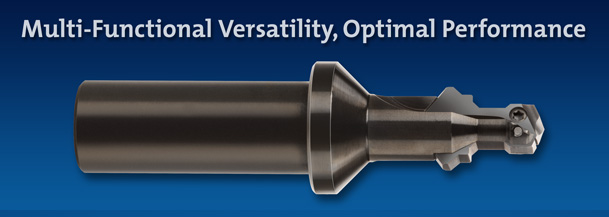
Adapter
|
Power
Chuck
|

|
| Tool
Holder |
CY32-300-32
SC-HM (MILLSTAR) |
| Holder
material |
Solid
carbide + modular tool head |
| Neck
diameter |
D2=22
mm (0.866 inch) |
| Neck
length |
L1=150
mm (6.0 inch) |
| Insert,
back draft |
BD-32-N
( R 2.6 ) MILLSTAR |
| Tool
coating |
Exalon
(AlTiN) |
| Toolpath
Strategy |
Spiral-type
removing of material |
| Cutting
Depth |
0
- 115 mm (0 - 4.528 inch) |
| Stock
remaining |
0.2
mm (0.008 inch) |
| Feed
/ spiral, ap |
<
0.26 degree (ap ~ 1mm per pass) |
| Feed |
2000
mm/min (78.75 inch/min.) |
| Spindle
speed |
1600
RPM (min/1) |
| Machining
time |
28
minutes |
 
| Machining
of the Back-Side (180 degree - side) |
|
Finishing |
|
Tool
Adapter
|
Power
Chuck
|

|
| Tool
Holder |
CY32-300-32
SC-HM (MILLSTAR) |
| Holder
material |
Solid
carbide + modular tool head |
| Neck
diameter |
D2=22
mm (0.866 inch) |
| Neck
length, step 1 |
L1=75
mm (3.00 inch) |
| Neck
length, step 2 |
L2=150
mm (6.00 inch) |
| Insert,
back draft |
BD-32-N
MILLSTAR |
| Tool
coating |
Exalon
(AlTiN) |
| Toolpath
Strategy |
Z-LEVEL
machining |
| Cutting
Depth |
0
- 60 mm (2.36 inch) |
| Stock
remaining |
0
mm |
| Step
down / pass, ap |
0.23
mm (0.009 inch) |
| Feed |
1600
mm/min (63.0 inch/min.) |
| Spindle
speed |
1300
RPM (min/1) |
| Machining
time |
18
minutes |

| Machining
of the Front-Side (0 degree - side) |
|
Roughing |
|
Tool
Adapter
|
Power
Chuck
|

|
| Tool
Holder |
CY32-300-32
SC-HM (MILLSTAR) |
| Holder
material |
Solid
carbide + modular tool head |
| Neck
diameter |
D2=22
mm (0.866 inch) |
| Neck
length, step 1 + 2 |
L1=150
mm + L2=240 mm |
| Insert,
back draft |
BD-32-N
Exalon MILLSTAR |
| Strategy |
Spiral-type
removing of material |
| Cutting
Depth |
0
- 50 mm (2.0 inch) |
| Stock
remaining |
0.2
mm (0.008 inch) |
| Feed
down / spiral, ap |
<
0.18 degree (ap ~ 0.32mm per pass) |
| Feed |
1000
mm/min (39.37 inch/min.) |
| Spindle
speed |
1600
RPM (min/1) |
| Machining
time |
15
minutes |
 
| Machining
of the Front-Side (0 degree - side) |
|
Finishing |
| Strategy |
Z-LEVEL
machining |
| Cutting
Depth |
0
- 25 mm (0 - 1.0 inch) |
| Feed |
800
mm/min (31.5 inch/min.) |
| Speed |
1200
RPM (min/1) |
| Machining
time |
25
minutes |
| Step
down / pass, ap |
0.2
mm (0.008 inch) |

Summary
Prior to this test many different competitive tools were
tested without success.
The
first roughing process was performed with the BD-20-N (CBN-tipped)
tool. It did not fail initially, but due to vibration and
poor geometrical cutting conditions this test was stopped.
Second
we tried the TO-32 toroid bull nose inserts. Cutting in
the first few levels was very smooth but when the tool was
in full nose radius contact, the cut resulted in bad vibration.
The large nose radius R= 8mm of these inserts created radial
forces which are too heavy for a tool extension and a length-to-diameter
relation of almost 10 to 1.
The
tools that performed best under these difficult conditions
were the BD-32-N inserts with an insert nose radius R =
2.6 mm. Cutting was strong but smooth. Over the cutting
time of about 30 minutes per hole (115 mm depth) the color
of the chips changed from yellow/gold into light blue. After
roughing the part, the tool showed slight wear but was still
good for additional finishing operations.
Conclusion
The customer was very satisfied with the test results. He
has purchased the first Makino machine and Millstar tooling.
The combination of the machining-technology of MAKINO and
the tooling-technology from MILLSTAR once again proved a
superior combination.
|